
Advanced Dental Associates provides fixed orthodontic treatments in San Antonio, TX, to correct moderate to severe bite misalignments and dental crowding. Traditional braces utilize a engineered system of low-profile brackets and high-flexibility archwires to systematically guide teeth into structurally correct, stable positions. Our practice designs customized orthodontic plans tailored directly to the anatomical and developmental needs of children, adolescents, and adult patients.
Quick Overview of Orthodontic Treatments:
-
Comprehensive Correction: Resolves complex malocclusions, including severe overbites, underbites, crossbites, and severely rotated teeth, that clear aligners cannot reliably manage.
-
Material Varieties: Patients can select traditional high-grade stainless steel hardware or discrete polycrystalline alumina (clear ceramic) brackets for a lower visual profile.
-
Diagnostic Mapping: We utilize digital cephalometric radiographs and 3D intraoral scanning to chart exact tooth progression without physical tray putties.
-
Financial Coordination: Our office provides structured in-house financing alternatives and works directly with major insurance providers to minimize out-of-pocket expenses.
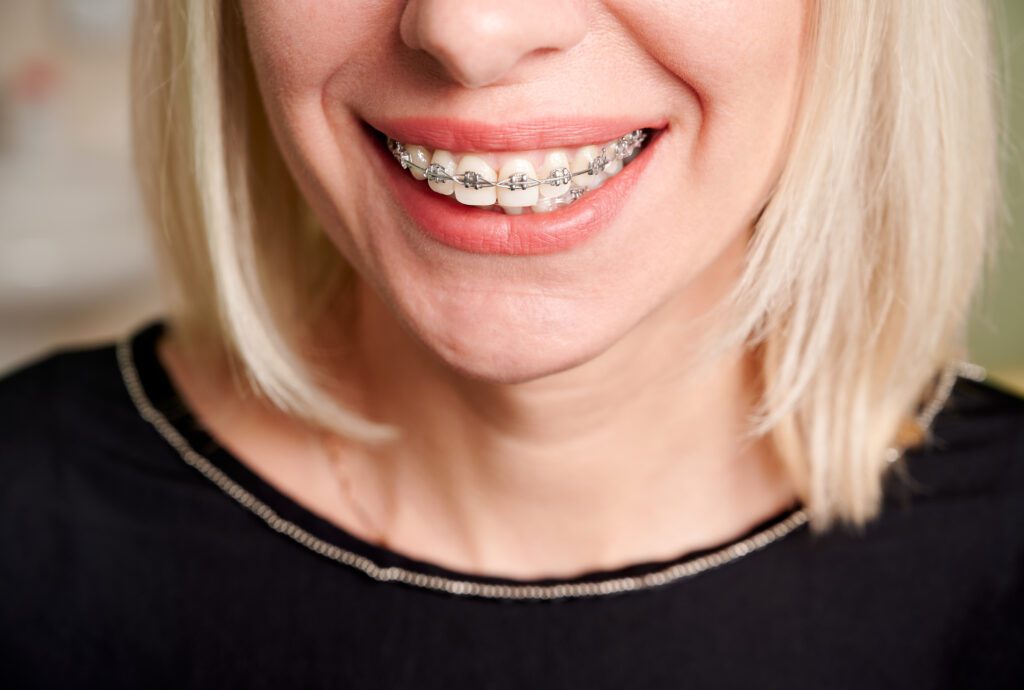
Orthodontic Systems & Hardware Anatomy
Fixed orthodontic appliances apply continuous, controlled mechanical force to safely guide teeth through the alveolar bone matrix. Modern traditional braces are significantly smaller, more streamlined, and more comfortable than legacy designs.
Traditional Metal Braces
Metal braces utilize low-profile brackets forged from high-grade stainless steel, which are bonded directly to the forward-facing enamel of each tooth using a medical-grade adhesive. A high-flexibility nickel-titanium or stainless steel archwire is threaded through these brackets. The wire is secured using small orthodontic ligatures (elastic bands). During periodic adjustments, our dentists replace or modify these wires to incrementally progress the teeth toward their target alignment.
Cosmetic Ceramic Braces
Ceramic braces use the exact same mechanical principles as metal appliances, but the brackets are constructed from polycrystalline alumina. These brackets are translucent or matched directly to the natural hue of human enamel, reducing their visibility at social distances. Ceramic brackets are highly resistant to structural staining and are frequently preferred by adult orthodontic patients requiring complex root movement.
Orthodontic Treatment Comparison Matrix
Review the objective attributes of fixed orthodontic systems compared to alternative alignment methods:
| Treatment System | Hardware Material | Primary Clinical Indication | Visibility Level | Diet & Hygiene Impact |
| Traditional Metal Braces | High-grade stainless steel | Severe crowding, advanced skeletal malocclusions | High visibility | Fixed appliance; requires dietary modifications and specialized flossing threaders. |
| Cosmetic Ceramic Braces | Polycrystalline alumina | Moderate to severe crowding, aesthetic priority | Low visibility | Fixed appliance; requires dietary modifications to prevent bracket fracture. |
| Invisalign® Clear Aligners | Medical-grade clear thermoplastic | Mild to moderate alignment issues, spacing gaps | Virtually invisible | Removable appliance; no dietary restrictions, standard brushing and flossing routine. |
Conditions Addressed by Fixed Orthodontics
Fixed braces provide a level of rotational and vertical tooth control that removable systems cannot achieve. Our San Antonio dentists utilize traditional braces to treat several complex dental and skeletal anomalies:
-
Overbite (Class II Malocclusion): A condition where the upper anterior teeth project significantly past the lower teeth, often leading to uneven wear on the lower incisors and soft-tissue irritation.
-
Underbite (Class III Malocclusion): Occurs when the lower jaw protrudes forward, causing the lower anterior teeth to sit outside the upper teeth. This can impair chewing mechanics and alter facial symmetry.
-
Crossbite: An alignment error where one or more upper teeth close inside the lower teeth. Left uncorrected, crossbites cause asymmetric jaw growth and localized enamel erosion.
-
Severe Crowding: When the jaw bone lacks sufficient arch length to accommodate the teeth, teeth rotate, overlap, and displace vertically, making oral hygiene difficult.
-
Diastemas (Widespread Spacing): Excess space in the jaw bone can cause teeth to drift abnormally, destabilizing the dental arch and leaving the gum tissue unprotected.
Clinical Benefits: Functional and Joint Protection
While fixed braces alter the visual alignment of your teeth, the primary purpose of traditional orthodontics is to protect long-term biological function and mechanical jaw health.
Mitigation of Enamel Erosion and Periodontal Disease
Severely crowded or rotated teeth create tightly compressed overlapping zones that block standard toothbrush bristles and dental floss. These areas harbor chronic reservoirs of plaque and tartar. Even with consistent home care, crowded teeth carry a statistically higher risk for localized decay and progressive periodontal gum disease. Straightening the teeth creates clean, accessible interproximal spaces, optimizing the efficacy of regular brushing and routine cleanings.
Jaw Stabilization and TMJ Protection
When teeth do not close in proper alignment, your biting forces are distributed unevenly across your dental arches. Specific teeth end up absorbing trauma-level mechanical pressures during chewing, which can lead to premature fractures, advanced enamel wear, or loose dental restorations.
This chronic imbalance forces the muscles, ligaments, and articular discs of the Temporomandibular Joint (TMJ) to constantly overcompensate to align the jaw. Over time, this mechanical strain triggers TMJ dysfunction, which can cause chronic tension headaches, localized facial muscle fatigue, clicking or popping sounds in the jaw joint, and progressive joint degeneration. Realigning the teeth establishes an even distribution of force, taking the stress off the jaw joints.
Frequently Asked Questions
Q: What bite conditions do traditional braces correct?
A: Traditional braces are highly effective for correcting complex malocclusions that clear aligners cannot reliably manage. These clinical concerns include severe overbites (upper teeth overlapping lower teeth), underbites (lower jaw protruding forward), crossbites (misaligned lateral tooth placement), advanced dental crowding, and deep skeletal bite discrepancies.
Q: How long do you have to wear traditional braces?
A: The average orthodontic treatment timeline with traditional braces ranges from 12 to 24 months. The exact duration depends entirely on the structural complexity of your jaw misalignment, the degree of crowding, and individual biological bone remodeling responses. Minor alignment issues may be resolved in under a year, while severe skeletal bite corrections require a longer timeline.
Q: Are traditional braces covered by insurance in San Antonio?
A: Many dental insurance policies provide partial coverage for traditional braces if the treatment is deemed medically necessary to resolve functional bite problems, particularly for patients under the age of 19. Adult orthodontics may require out-of-pocket payment. Advanced Dental Associates offers structured in-house financing options to keep out-of-pocket expenses manageable.
Arrange an Orthodontic Consultation at Our San Antonio Practice
We combine advanced digital diagnostic imaging with specialized fixed appliance techniques to resolve complex structural and alignment issues. To maintain the long-term structural health of your teeth and evaluate early developmental alignment requirements, we recommend diagnostic evaluations every six months.
If you are exploring alternative, lower-profile alignment methods for mild to moderate crowding, you can read about our alternative Invisalign Clear Aligners treatments.
To schedule your personal orthodontic evaluation, call our San Antonio office at 210-655-2753 or complete our secure online appointment request form.